
On 14 March 2024, network operators reported that four submarine cables had been damaged off the coast of Abidjan, Côte d’Ivoire. These were the ACE, Main One, SAT-3 and WACS submarine cables, which run from South Africa and Nigeria to Europe and supply the bulk of Internet connectivity to West Africa. The breaks to these cables resulted in nationwide Internet outages in twelve countries across the region, with capacity incrementally returning as Internet traffic was restored via other cable systems until these damaged four cables can be repaired during April.
“On Thursday, March 14, 2024, at 7:43 GMT, we experienced a fault on the MainOne network,” confirmed Main One in a press release. “Preliminary findings and further investigations revealed that the fault occurred most probably due to environmental factors such as landslides and earthquakes, that resulted in a cut on our submarine cable system, in the Atlantic Ocean, offshore Cote D’Ivoire, along the coast of West Africa. Given the distance from land, and the cable depth of about 3 kms at the point of fault, any kind of human activity – ship anchors, fishing, drilling etc has been immediately ruled out.”
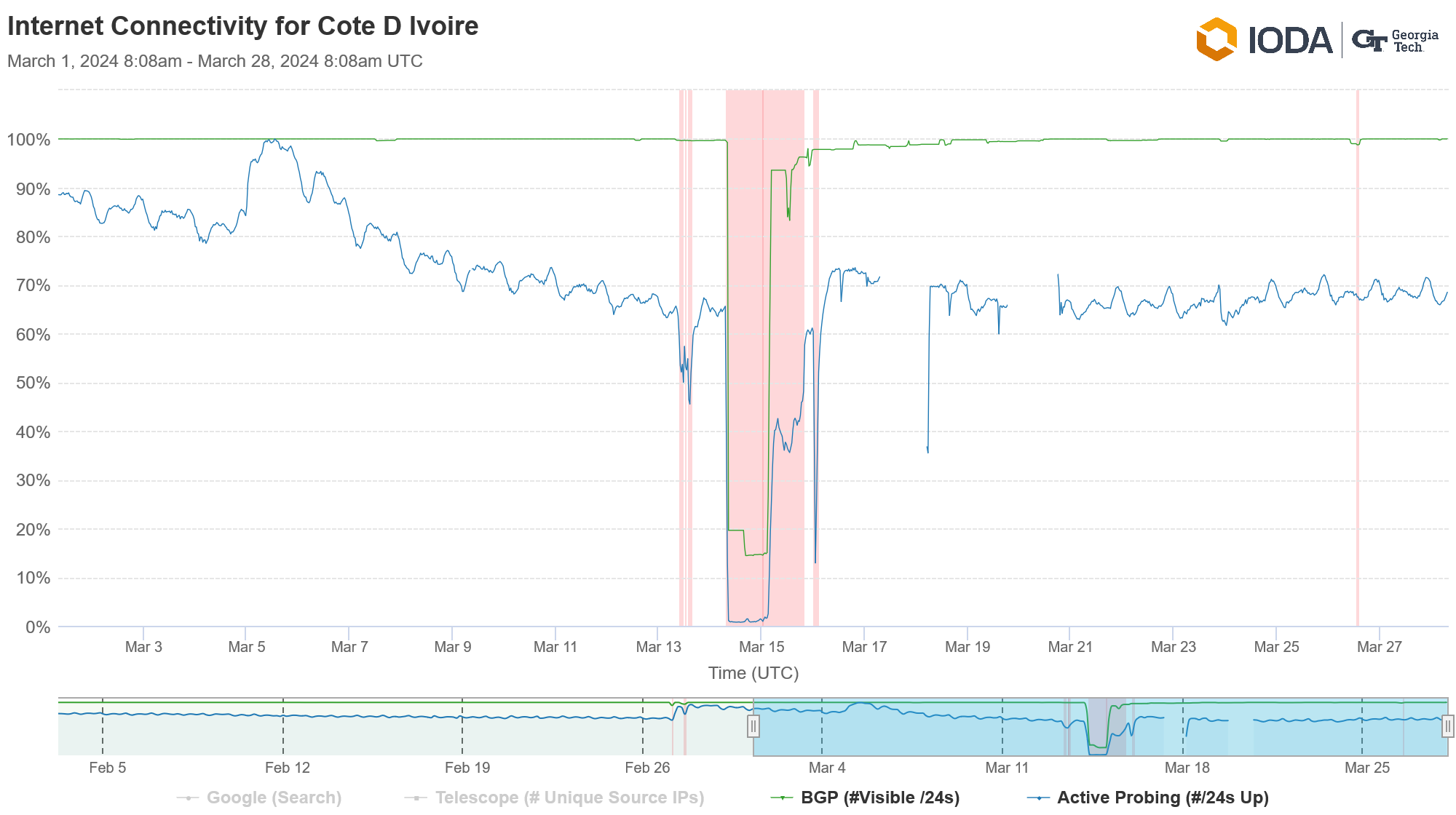
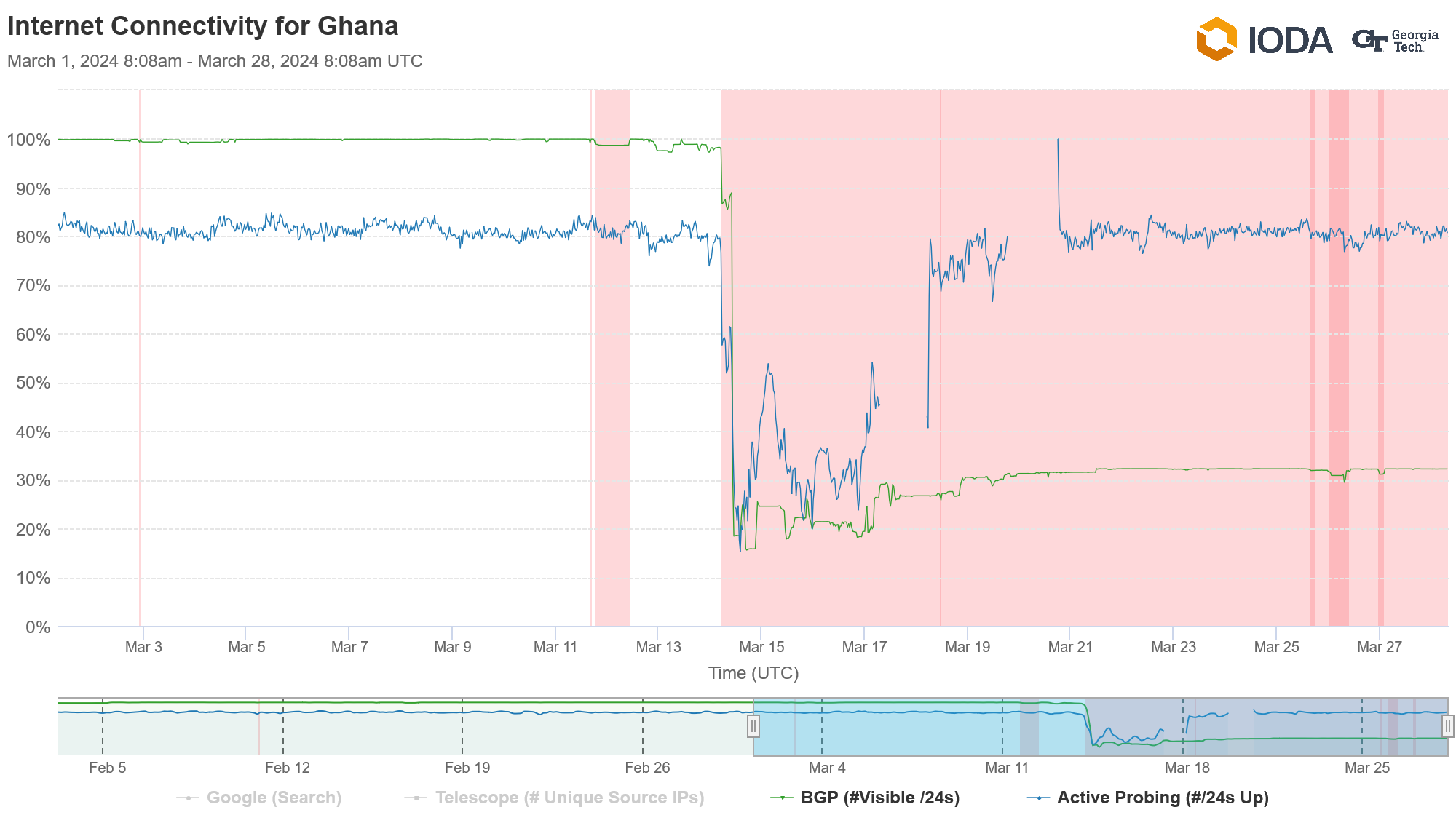
According to IODA (Internet Outage Detection and Analysis), Internet traffic dropped on 14 March to as low as 14% of normal in Côte d’Ivoire, 16% in Ghana, 17% in Sierra Leone, 21% in Burkina Faso, 23% in Guinea, 29% in Benin, 37% in Cameroon, 38% in Liberia, 56% in Namibia, 69% in Nigeria, 70% in Congo, 77% in Niger, and 86% of normal in Guinea Bissau. Meanwhile, Senegal, The Gambia, Mali, Togo, Equatorial Guinea and Gabon which rely on unaffected cable systems saw normal traffic patterns.
Côte d’Ivoire’s utilised international Internet bandwidth reached 963.394 Gbps in December 2023, with five submarine cables landing at Abidjan: SAT-3, ACE, WACS, MainOne, and Maroc Telecom West Africa cable. The total of 963.394 Gbps was split between Orange which had 447.365 Gbps of utilised international bandwidth, MainOne which had 376.029 Gbps, and MTN which had 140 Gbps (see Côte d’Ivoire: Côte d’Ivoire’s International Bandwidth Increases By 76% During 2023). Côte d’Ivoire’s international Internet traffic dropped to 20% of normal at 8.30am on 14 March, then decreased further to 14% by 16.30pm, this recovered to 27% by 3.00am, 53% by 3.30am, 74% by 4.00am and 94% by 4.30am on 15 March.
Source: IODA
Network operators have rerouted traffic onto other cable systems until the damaged cables can be repaired. On 16 March, National Communications Authority (NCA) of Ghana said that operators reported there was a minimum timeframe of five weeks for full restoration of service from the time that repair vessels are dispatched to the various locations. For example, Bayobab said that it had restored operations as of 19 March, recovering over 3 Terabits per second (Tbps) of capacity across its footprint. WIOCC said that it had activated an additional 2 Terabits per second (Tbps) of capacity across the unaffected cables in its network to support the capacity needs of other network operators.
Five other cable systems were unaffected: Equiano (which lands in Togo, Nigeria, Namibia, South Africa), GLO-1 (Ghana, Nigeria), Maroc Telecom West Africa Cable (Morocco, Côte d’Ivoire, Togo, Benin, Gabon), SAIL (Cameroon to Brazil), and SACS (Angola to Brazil). The 2Africa cable currently under deployment has not yet entered service. In addition, traffic was also rerouted onto other submarine cables via the East coast of Africa. However, this follows just two weeks after four other submarine cables were cut in the Red Sea (see Africa: Four Submarine Cables Damaged In Red Sea).
Two weeks after the event by 28 March, Ghana is still experiencing lower than normal capacity (see chart below). Ghana’s international Internet bandwidth reached 1.510 Tbps in 2022 (see Ghana: Ghana's International Bandwidth Reaches 1.5 Tbps, Dec 2022), of which 98% was supplied by these four cables: 41.37% (624 Gbps) on the WACS cable, 26.36% on Main One (398 Gbps), 22.01% on ACE (332 Gbps), 8.28% on SAT-3 (125 Gbps), and 1.99% on GLO-1 (30 Gbps). The NCA said in a statement on 14 March 2024 that Ghana had lost 1,596.6 Gbps of data capacity as a result of the multiple undersea cable cuts, with 100% of capacity lost on SAT-3, and 90% of capacity lost on ACE, Main One and WACS.
Source: IODA
Source: Bayobab, IODA, Main One, NCA, Reuters, WIOCC
Comments are closed!