
Submarine cables landing in sub-Saharan Africa currently reach 37.4 million people within a 25-km range of landing stations, equivalent to 4.4% of the total population. This will increase to 46.6 million (5.5%) once additional landing points for the WACS, ACE, and SEAS submarine cables have been completed in 2011 and 2012.
The thirteen submarine cable systems with landings in sub-Saharan Africa have a total design capacity of 14.0 Tbps, which will now almost double to 25.8 Tbps by the end of 2012, but the key is delivering this capacity to customers.
Africa’s terrestrial fibre optic networks reach some 259.3 million people within a 25-km range of operational fibre nodes, some 30.8% of the population. Once fibre network which is currently under construction is completed, this will grow to 313.3 million (37.2%), and if network which is currently planned or proposed is completed, this will increase again to 388.2 million (46.1%).
Table: Comparison of Reach Between Submarine and Terrestrial Fibre Networks, Sub-Saharan Africa
| % Popn 10-km | % Popn 25-km | % Popn 50-km | Popn 10-km | Popn 25-km | Popn 50-km | |
|---|---|---|---|---|---|---|
| Submarine Cable Landing Point - Operational | 1.8% | 4.4% | 5.9% | 15,228,657 | 37,435,945 | 49,784,793 |
| Submarine Cable Landing point - Planned | 2.5% | 5.5% | 7.2% | 20,776,374 | 46,625,420 | 61,250,237 |
| Terrestrial Fibre Node - Operational | 15.6% | 30.8% | 47.7% | 131,230,412 | 259,327,721 | 401,057,432 |
| Terrestrial Fibre Node - Under Construction | 18.4% | 37.2% | 57.9% | 155,168,393 | 313,280,142 | 486,944,473 |
| Terrestrial Fibre Node - Planned or Proposed | 23.2% | 46.1% | 69.9% | 194,941,499 | 388,137,052 | 588,314,854 |
Source: Hamilton Research.
Notes: A country-by-country breakdown of the data for submarine cable reach are published as two new datasets for subscribers.
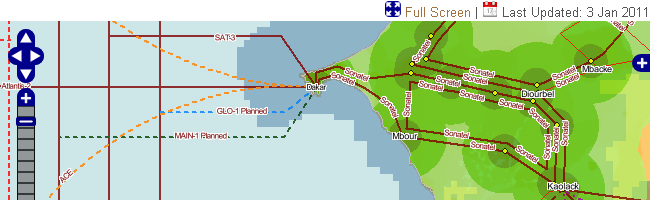
In Senegal for example, 25.1% of the population (3,297,726) live within a 25-km range of the submarine cable landing points in Dakar (the capital). However, as the view below taken from the Gold Transmission Map shows, Sonatel’s extensive fibre backbone currently reaches 71.9% of the population (9,439,405) within a 25-km range, and 92.7% within a 50-km range. The Atlantis-2 and SAT-3 cables currently land in Dakar. This will be followed by ACE (2012), Globacom obtained a licence last year to land the GLO-1 cable in Dakar, and Main One also plan to land in Dakar too.
Whilst it is true that most cables land in the largest cities (Abidjan, Accra, Lagos, Dar es Salaam and so on), some do not. In Kenya for example, only 3.4% of the population lives within a 25-km range of the cable landing point in Mombasa and in South Africa just 3.1% of the population live within a 25-km range of Melkbosstrand and Mtunzini.
The deployment of terrestrial fibre networks expands the size of the market that can be reached with high capacity backbones. In Gabon for example, 35.3% of the population (527,646) live within a 25-km range of the SAT-3 submarine cable landing point in Libreville (the capital). In addition, the ACE cable will land in Libreville in 2012. Meanwhile, Gabon Telecom is building a 3,000-km national fibre backbone which, it is planned will be completed by the end of 2012, will reach 80% of the population (1,197,326) within a 25-km reach of an operational fibre node.
Africa Telecom Transmission Map Updates Q4, 2010
In the fourth quarter of 2010, a total of 41,791-kms of network was added or edited in the African Telecom Transmission Map, bringing the total inventory to 617,773-km. By comparison, in July 2010 this stood at 585,471–km, and in July 2009 at 465,659-km (restated).
A total of 337 changes were made to terrestrial transmission networks on the map during the quarter, with fibre backbones extended in Angola, Botswana, Ethiopia, Kenya, Malawi, Namibia, Nigeria, Rwanda, Somalia, South Africa, and Tanzania. This included 16,321-km of operational fibre, 4,956-km of fibre under construction, 8,177-km of fibre which was planned, and 8,001-km of fibre which was proposed. A further 4,336-km of microwave network was either added or edited.
[private]A country-by-country breakdown of the data for submarine cable reach are published as two new datasets at Submarine Cable Reach (Operational) and Submarine Cable Reach (Planned). Country-by-country breakdown of the data for terrestrial fibre reach are available for Silver and Gold subscribers, published at Fibre Reach (Operational), Fibre Reach (Under Construction), and Fibre Reach (Planned).
Fibre Long Haul
- Angola: Angola’s National Fibre Backbone Reaches 6,000-kms, 60% Complete
- Cameroon: CAMTEL Completes 450-Km Southern Fibre Optic Route To Kye Osi
- Ethiopia: ETC Completes 526-Km Fibre Link To Moyale, Kenya
- Ghana: NCBC Extends Fibre Backbone To Paga On Border With Burkina Faso
- Liberia: Liberia Creates Special Purpose Vehicle For Landing Station and National Fibre Backbone
- Rwanda: RDB Announces Completion of National Fibre Backbone Rollout
- Somalia: SomCable Building 930-Km Fibre Backbone From Loyada To Las-Anod
- South Africa: FibreCo Telecommunications To Build 12,000-km Open Access National Fibre Network in South Africa
- South Africa: Broadband Infraco Launches As Open Access Wholesale Service Provider in South Africa
- Uganda: KDN Resumes Fibre Rollout From Kampala - Gatuna
- Zimbabwe: Liquid Telecom Completes 740-Km Fibre Route To South Africa, Accesses SEACOM
- Zimbabwe: TelOne Fibre “40-km Away From Mozambican Border”
- Zimbabwe: TelOne Fibre Reaches Mozambican Border, Expects to Launch Network Soon
Cross-Border Routes
Four cross-border fibre routes were completed during the quarter. A fibre route between Ethiopia and Kenya was completed at Moyale, and between Angola and Namibia was completed at Oshikango. Meanwhile, Liquid Telecom completed the fibre link from Harare (the Zimbabwean capital) to South Africa at Beitbridge, and Tel*One completed a fibre link from Harare to Mozambique at Mutare.
- Angola: Angola’s National Fibre Backbone Reaches 6,000-kms, 60% Complete
- Ethiopia: ETC Completes 526-Km Fibre Link To Moyale, Kenya
- Zambia: ZAMTEL Signs MoU With BTC For Cross-Border Fibre Link At Kazungula
- Zimbabwe: Liquid Telecom Completes 740-Km Fibre Route To South Africa, Accesses SEACOM
- Zimbabwe: TelOne Fibre Reaches Mozambican Border, Expects to Launch Network Soon
Submarine Cables
Two new submarine cables entered service during the quarter: GLO-1 (October 2010), and IMEWE (December 2010). In addition, LITC awarded a contract for the Silphium submarine cable connecting Darnah (Libya) to Chania (Greece), and Seychelles Cable System (SCS) awarded a contract to build the 1,900-km Seychelles East Africa System (SEAS) linking the Seychelles with Dar es Salaam (Tanzania).
- Cape Verde: WACS Submarine Cable Lands In Cape Verde
- Egypt: IMEWE Submarine Cable Enters Commercial Service
- Libya: LITC Award Contract For Silphium Submarine Cable To Huawei Marine Networks
- Nigeria: GLO-1 Submarine Cable Enters Commercial Service, October 2010
- Seychelles: Seychelles Cable System (SCS) Awards Contract For SEAS Submarine Cable To Alcatel Lucent
Capacity
By the end of December 2010, the total design capacity on submarine cables landing in sub-Saharan Africa reached 13.959 Tbps, up from 7.881 Tbps at the end of 2009, and 4.151 Tbps at the end of 2008. With the introduction of 40G technology on submarine cables, the total design capacity will reach 19.079 Tbps by December 2011, and 25.799 Tbps by December 2012. The launch of submarine cables has had a huge impact on East Africa. In the first year since the first cable (SEACOM) entered service in July 2009, Kenya had reached an inbound bandwidth of 20 Gbps by June 2010, Tanzania of 2.8 Gbps, Uganda of 2.5 Gbps, and Rwanda of 695 Mbps.
- Africa: EASSy Announces System Upgrade, To More Than Double "Lit" Capacity During 2011
- Djibouti: Djibouti Telecom and Telecom Italia Sparkle Sell Over 1 GB Connectivity Through New IP POP
- Kenya: Kenya Reaches 20 Gbps International Bandwidth, June 2010
- Rwanda: Rwanda Reaches 695 Mbps International Bandwidth, June 2010
- Tanzania: Tanzania Reaches 2.8 Gbps International Bandwidth, June 2010
- Tunisia: Tunisie Telecom Increases International Bandwidth To 50 Gbps
- Zambia: Gateway Communications Extends Terrestrial Data Network, Commissions STM-1 Fibre Route To Zambia
[/private]
Comments are closed!